Business teams waste hours each week pulling data from different tools just to create basic reports. Most dashboard platforms promise to solve this problem but end up creating new ones – complex interfaces, steep learning curves, and pricing that scales with success.
The right dashboard solution should connect your data sources, display insights clearly, and fit your team’s existing workflow.
Here are eight proven alternatives to Databox that deliver on these promises.
What is Databox?
Databox is a business intelligence platform focused on KPI tracking and real-time performance monitoring. The tool connects to over 130 data sources including popular marketing platforms like Google Analytics, HubSpot, and Facebook Ads.
Core Databox features include:
- Mobile-first dashboard design for on-the-go monitoring
- Pre-built KPI templates for common business metrics
- Goal tracking with automated alerts and notifications
- Client reporting with white-label customization options
- Drag-and-drop dashboard builder for non-technical users
Target audience: Small to medium businesses, marketing agencies, and teams that need quick insights without complex data analysis. The platform emphasizes speed and simplicity over advanced analytical capabilities.
Why look for Databox alternatives?
Despite its strengths, Databox has several limitations that drive teams toward alternatives:
Pricing concerns affect growing teams most
- Professional plan: Starts at $159 monthly
- Costs climb quickly: Adding more data sources or advanced features
- Free tier limitations: Teams outgrow quickly
Limited customization frustrates power users
- Standard KPIs focus: Doesn’t handle complex data transformations
- Custom metrics limitations: Poor support for specific calculations
- Visualization restrictions: Limited chart and display options
Mobile-first design creates desktop problems
- Great for executives: Checking metrics on phones
- Poor for detailed analysis: Desktop computer limitations
- Interface priorities: Simplicity over functionality
Dashboard dependency locks teams in
- Visualization style: Stuck with Databox’s approach
- Sharing method limitations: Can’t export data easily
- Workflow integration: Difficult to integrate with existing reporting
Learning curve issues despite user-friendly marketing
- Non-technical users struggle: Metric creation complexity
- Dashboard setup challenges: More difficult than advertised
- Training requirements: Steeper than expected
Top 8 Databox alternatives
1. Coefficient – “The spreadsheet-native dashboard solution”

Best for: Business teams comfortable with spreadsheets who need live data without dashboard complexity
Coefficient transforms spreadsheets into powerful dashboards by connecting live business data directly to Excel and Google Sheets. This approach eliminates the need to learn new visualization tools while providing enterprise-grade data connections.
Key features:
- Live data connections to 70+ business systems (Salesforce, HubSpot, Google Analytics)
- Native spreadsheet formulas and functions for custom calculations
- AI Sheets assistant for automated insights and analysis
- Real-time data refresh without manual exports
- Familiar interface works entirely within Excel/Google Sheets
Pricing:
- Plans start: $49/month per user
- Unlimited data sources and real-time refresh capabilities
- No dashboard platform fees beyond spreadsheet licensing
Best fit: Financial analysts, operations managers, and anyone who prefers spreadsheet flexibility over rigid dashboard layouts.
Why choose over Databox: Skip the learning curve entirely. Coefficient keeps your team in tools they already know while providing more powerful data connections and analysis capabilities than traditional dashboard platforms.
Considerations: Requires spreadsheet comfort level, less polished presentation than dedicated dashboard tools.
2. Klipfolio – “Advanced customization for data-driven teams”

Best for: Excel power users, agencies building client reports, and mid-market businesses with complex data requirements
Klipfolio combines spreadsheet-like data manipulation with professional dashboard presentation. The platform targets users who need more control over their data than simple dashboard builders provide.
Key features:
- 200+ service integrations including APIs and SQL databases
- Advanced data modeling with joins and transformations
- Custom visualization options beyond standard charts
- Spreadsheet-style formulas for complex calculations
- Client dashboard templates for agency reporting
Pricing:
- Base plan: $120/month for 3 dashboards with unlimited users
- Scale up: To $600/month for real-time updates and priority support
- Per-dashboard model rather than per-user pricing
Best fit: Teams that need advanced data manipulation but want professional dashboard output.
Strengths: Powerful data modeling capabilities and familiar spreadsheet-style interface.
Limitations: Higher learning curve than simple dashboard tools, complex pricing structure.
3. Geckoboard – “Simple KPI displays for team visibility”

Best for: Teams needing live KPI monitoring, operations centers requiring status displays, and small businesses wanting quick dashboard setup
Geckoboard focuses exclusively on real-time KPI visualization with minimal setup complexity. The platform prioritizes live data display over comprehensive analytics.
Key features:
- 90+ direct integrations with business tools
- Real-time data refresh for live monitoring
- TV/display mode optimized for office screens
- Drag-and-drop builder with pre-built widgets
- Secure sharing options for different team levels
Pricing:
- Essential plan: $44/month covers basic needs
- Pro plan: $87/month adds advanced integrations and sharing features
- Cost-effective for straightforward monitoring needs
Best fit: Straightforward monitoring needs without analytical complexity.
Strengths: Extremely easy setup, excellent real-time capabilities, and clean interface design.
Limitations: Limited analytical capabilities, fewer customization options than comprehensive platforms.
4. Grafana – “Open-source powerhouse for technical teams”

Best for: DevOps teams, technical organizations with custom requirements, and companies needing advanced monitoring capabilities
Grafana started as an infrastructure monitoring tool and evolved into a comprehensive visualization platform. It offers both free open-source and paid enterprise versions.
Key features:
- Extensive plugin ecosystem with community contributions
- Multiple data source support and query languages
- Advanced alerting and notification systems
- Custom dashboard development with full control
- High availability and scalability options
Pricing:
- Open source version: Completely free
- Enterprise features: Custom pricing for support and advanced functionality
- No licensing costs for basic use
Best fit: Organizations with development resources and custom monitoring requirements.
Strengths: Extremely powerful and flexible platform with large community support.
Limitations: Requires technical expertise, complex setup for non-technical teams.
5. Whatagraph – “Marketing-focused reporting for agencies”

Best for: Digital marketing agencies, in-house marketing teams focused on campaign ROI, and businesses needing automated client reporting
Whatagraph specializes in marketing dashboard creation with particular strength in agency use cases. The platform emphasizes automated reporting and white-label capabilities.
Key features:
- 45+ marketing-focused integrations (social media and advertising platforms)
- Cross-channel marketing performance reports
- Automated report scheduling with branded templates
- White-label customization with custom domains
- AI-powered insights for campaign optimization
Pricing:
- Custom pricing based on data sources and features
- Free trial available but specific costs require sales consultation
- Agency-focused pricing structure
Best fit: Agency workflows requiring automated client reporting.
Strengths: Deep marketing integration focus, excellent automation features, and professional white-label capabilities.
Limitations: Sales-led pricing creates uncertainty, limited beyond marketing use cases.
6. Sisense – “Enterprise analytics for complex data needs”

Best for: Large enterprises with complex data requirements, organizations needing embedded analytics, and companies with dedicated data science teams
Sisense targets large organizations with AI-powered analytics and embedded business intelligence capabilities. The platform handles large datasets and provides advanced analytical features.
Key features:
- AI assistant for natural language data queries
- Advanced machine learning and forecasting capabilities
- Complex data modeling with ETL processes
- Embedded analytics for custom applications
- Enterprise security and governance features
Pricing:
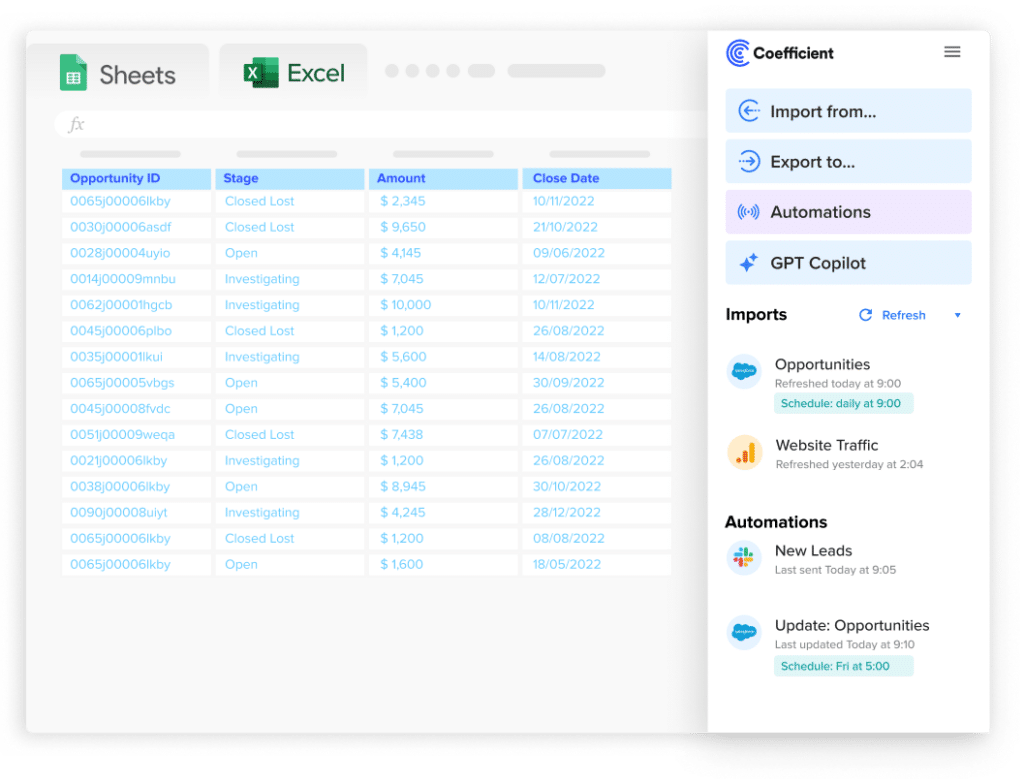
Stop exporting data manually. Sync data from your business systems into Google Sheets or Excel with Coefficient and set it on a refresh schedule.
Get Started
- Entry level: Around $40,600 annually
- Enterprise plans: Can reach $327,000+ yearly
- Deployment and feature-dependent pricing
Best fit: Large-scale enterprise data requirements and regulated industries.
Strengths: Very powerful AI and machine learning features, excellent scalability, comprehensive security features.
Limitations: Extremely high cost, complex implementation, overkill for small-medium businesses.
7. Mixpanel – “Product analytics for user behavior tracking”

Best for: SaaS companies, mobile app developers, product managers focused on user engagement, and growth teams analyzing conversion funnels
Mixpanel specializes in product analytics and event tracking, focusing on user behavior rather than business operations. It combines dashboard visualization with sophisticated behavioral analysis.
Key features:
- Advanced event tracking and user journey analysis
- Behavioral cohort studies and retention analysis
- A/B testing integration with statistical significance
- Custom event definitions for product-specific metrics
- Mobile app analytics with deep user segmentation
Pricing:
- Free tier: Up to 1 million events monthly
- Growth plan: $0.28 per 1,000 events after free limit
- Enterprise plans: Custom pricing
- Usage-based model scales with product growth
Best fit: Product teams focused on user behavior and engagement metrics.
Strengths: Exceptional event tracking capabilities, deep user behavior insights, flexible usage-based pricing.
Limitations: Specialized for product analytics, not suitable for general business reporting.
8. Grow – “Business intelligence for scaling teams”

Best for: Small to medium businesses seeking comprehensive BI, organizations wanting unlimited user access, and teams needing both simple and advanced features
Grow positions itself as full-stack business intelligence without technical complexity. The platform emphasizes unlimited users and comprehensive BI capabilities for growing organizations.
Key features:
- 150+ data source integrations across business functions
- Combined ETL, data warehousing, and visualization in one platform
- No-code interface for business user independence
- Unlimited users and dashboards in all plans
- Custom data transformation without technical skills
Pricing:
- Growth plan: $165/month includes unlimited users and dashboards
- Enterprise features: Custom pricing consultation
- Unlimited user model provides value for growing teams
Best fit: Growing teams needing comprehensive BI without per-user limitations.
Strengths: Unlimited user model, full-stack BI capabilities handle everything from data connection to visualization.
Limitations: Higher starting cost than simple dashboard tools, may be complex for basic monitoring needs.
How to choose the right Databox alternative
Start with your team’s technical comfort level
Simple setup preferences:
- Geckoboard: Easy KPI monitoring
- Whatagraph: Marketing-focused templates
- Coefficient: Spreadsheet-native approach
Technical capability available:
- Grafana: Open-source flexibility
- Sisense: Enterprise-grade analytics
- Klipfolio: Advanced data modeling
Consider your data complexity needs
Basic KPI monitoring:
- Geckoboard: Real-time displays
- Simple dashboard tools: Standard visualizations
- Template-based solutions: Quick setup
Complex analysis requirements:
- Klipfolio: Advanced data transformations
- Sisense: Machine learning capabilities
- Coefficient: Spreadsheet-based calculations
- Custom analytics needs: Specialized platforms
Evaluate integration requirements carefully
Assessment checklist:
- Count current data sources: Check each platform’s connector library
- Future tool adoption: Some platforms add integrations faster
- API requirements: Custom connections for unique tools
- Database connectivity: Direct SQL access needs
Factor in total cost of ownership
Beyond monthly fees consider:
- Setup time requirements: Initial configuration effort
- Training requirements: Team learning curve
- Ongoing maintenance: Platform administration needs
- Per-user vs per-dashboard: Pricing model implications
Pricing model comparison:
- Per-user pricing: Can get expensive quickly (Databox, Sisense)
- Per-dashboard models: May limit reporting flexibility (Klipfolio)
- Unlimited users: Better for growing teams (Grow)
- Usage-based: Scales with activity (Mixpanel)
Test with real data during trials
Evaluation best practices:
- Connect actual data sources: Generic demos don’t reveal workflow friction
- Team member testing: Have users create reports they’d use daily
- Workflow integration: Test how platform fits existing processes
- Performance evaluation: Check speed with real data volumes
Transform your business reporting workflow
The best Databox alternative depends on your team’s specific needs, technical skills, and workflow preferences. Simple KPI monitoring works well with tools like Geckoboard, while complex analysis requires platforms like Sisense or Grafana.
Each platform serves different priorities. Marketing teams gravitate toward Whatagraph’s automation. Technical teams appreciate Grafana’s flexibility. Enterprise organizations need Sisense’s advanced capabilities.
For teams comfortable with spreadsheets, Coefficient offers the unique advantage of working within Excel and Google Sheets while providing enterprise-grade data connections. This approach eliminates learning curves and fits existing workflows better than traditional dashboard platforms.
Ready to try a spreadsheet-native approach to business reporting? Get started with Coefficient and connect your business data to the tools your team already knows and loves.