When you’re managing financial reporting across NetSuite, Snowflake, and multiple business systems, you’re likely evaluating data connectivity platforms that promise to end the nightmare of manual exports and copy-paste workflows. Two names frequently come up in this search: Cube and Datarails. Both are well-regarded in their respective spaces, but here’s the problem—they represent opposite extremes.
Cube offers a no-code FP&A platform designed for small businesses and startups who want spreadsheet-native financial planning without leaving Excel or Google Sheets. It’s user-friendly, integrates directly with business systems, and comes with AI-powered features.
Datarails, on the other hand, is an Excel-native FP&A platform built specifically for finance teams who want automated consolidation without leaving their spreadsheets. It’s finance-focused, enterprise-ready, and comes with dedicated support.
So which one wins? Neither, actually—at least not for most mid-market teams. Here’s why:
- Cube’s limitations with complex multi-dimensional models may frustrate growing companies
- Datarails locks you into expensive, Excel-only functionality that doesn’t serve cross-platform teams
In this comparison, we’ll break down what each platform does well, where they fall short, and why there’s a third option that might work better for teams caught between these two extremes.
Cube overview

Cube positions itself as a no-code FP&A platform for strategic finance teams. Rather than replacing spreadsheets, Cube enhances them by providing a layer of automation, control, and real-time data connectivity that traditional spreadsheets lack.
For finance teams at small businesses and startups, Cube is genuinely appealing. The platform seamlessly integrates with Excel and Google Sheets, bringing enterprise-level FP&A functionality into familiar environments where finance professionals feel most at home. Cube pairs the flexibility and familiarity of your spreadsheet with the control & scale of performance software, enabling teams to get started in days, not months.
The platform earned:
- #1 ranking for implementation and ROI on G2
- 4.5-4.7 rating across review platforms with 140+ reviews
- #1 for ease of use, fastest implementation, and best support across FP&A platform categories
- Awards including Best Relationship and Fastest Implementation

Cube connects directly to ERPs (NetSuite, QuickBooks, Sage Intacct, Xero), CRMs (Salesforce, HubSpot), HR systems, and business intelligence tools. The platform can connect with a wide range of data sources, ensuring a seamless flow of information into the FP&A process.
What makes Cube unique is its focus on the strategic finance function. The platform includes:
- AI-enhanced forecasting that adapts instantly to change
- What-if scenario modeling without complex formulas
- Automated variance analysis and KPI tracking
- Real-time reporting with compelling visualizations
- Integrated workflows and version tracking
Cube was made for and focuses on small businesses and startups. While companies like Workday Adaptive Planning serve large enterprise corporations and Datarails caters to small and medium-sized scalable businesses, Cube’s platform focuses exclusively on small businesses and startups. Many Cube users require budgeting, forecasting, and reporting across departments but lack the budget or patience for a heavy enterprise solution.
Unfortunately, Cube’s pricing model is gated by sales.

Datarails overview

Datarails takes a similar but distinct approach. Instead of serving all spreadsheet users, it transforms Excel specifically into what the company calls a “lean, mean FP&A machine.” The positioning is crystal clear: this is FP&A software for Excel users who want to stay in Excel while gaining automated data consolidation, version control, and collaboration capabilities.
For finance teams who live in Excel, Datarails offers genuine appeal. The platform integrates natively with Excel through the Datarails Flex add-in, maintaining:
- 100% Excel functionality
- Cloud-based storage
- Real-time collaboration
- Automated data imports from 200+ sources
You’re not learning a new tool—you’re supercharging the spreadsheet environment you already know. Build your models the same way you always have, but now with live data feeding in automatically instead of manual CSV exports.
The implementation timeline is impressively fast: two weeks typical versus months for traditional FP&A platforms like Planful or Adaptive Insights. Customer support is exceptional, with dedicated customer success managers (CSMs) earning:
- 4.9/5 rating on Capterra
- Platform itself holds 4.6/5 rating on G2 with 213 reviews

Described by Datarails as “the highest rating in the FP&A software industry,” that’s a strong signal that users genuinely appreciate what the platform does.
Beyond basic connectivity, Datarails offers purpose-built FP&A capabilities:
- Budget creation and collection workflows
- Rolling forecasts
- Scenario analysis
- Multi-entity consolidation
- Automated financial statement generation
The “Genius by Datarails” AI features add conversational analytics—ask questions about your financial data in natural language and get dashboard recommendations or automated insights. For finance teams managing complex corporate structures with multiple entities, Datarails handles consolidation workflows that generic data connectors simply can’t match.
But here’s where Datarails becomes challenging for many mid-market teams: pricing.
While the company doesn’t publish rates publicly (you need to request a custom quote), third-party research consistently cites a range of:
- $3,000 to $5,000+ per month
- $36,000 to $60,000 annually—or more

For startups and mid-market companies with lean teams, that’s a significant investment, especially when you’re only solving data connectivity for one department.
Head-to-head comparison
Data source connectors
Let’s start with the most fundamental question: what data can each platform actually access?
Cube’s integration strategy focuses on direct connections to business systems that finance teams actually use. Cube connects directly to:
- Financial ERPs: NetSuite, QuickBooks, Sage Intacct, Xero, Microsoft Dynamics
- CRM Systems: Salesforce, HubSpot
- HR/Payroll: Various HRIS platforms
- Business Intelligence: Connection to BI tools
- Databases: For teams that have consolidated data
The platform offers both out-of-the-box integrations and custom connection options. For finance teams, this direct connectivity to source systems is exactly what they need. Pull in your ERP data, combine it with CRM pipeline information, and build financial statements directly in Excel or Google Sheets.
Datarails takes a similar approach, claiming 200+ integrations focused heavily on finance and accounting systems. Datarails connects directly to core financial systems:
- NetSuite
- QuickBooks
- Sage Intacct
- Xero
- Other accounting ERPs
With no data warehouse required. For finance teams, this is exactly what they need. Pull in your ERP data, combine it with bank feeds and payment processors, and build financial statements directly in Excel. The integrations are designed for finance workflows:
- Accounts receivable aging
- General ledger detail
- Cash flow tracking
- Budget vs. actual reporting
The limitation with Datarails is breadth beyond finance. While the platform claims 200+ integrations, the vast majority serve financial and accounting use cases. If you need:
- Marketing analytics from Google Ads
- Sales pipeline data from Salesforce
- Customer support metrics from Zendesk
- Operational data from project management tools
Datarails’ integration library becomes less relevant. It’s built for finance teams, not cross-functional data consolidation.
Data destinations and flexibility
Once you’ve connected to data sources, where can that data actually go?
Cube’s entire architecture is designed to be spreadsheet-native. Data flows:
- From source systems into Cube’s platform
- Then directly into Excel and Google Sheets where users work
The platform maintains full spreadsheet functionality while adding:
- Real-time data connectivity
- Version control
- Collaboration features
- Automated refresh capabilities
For teams that do their actual analysis and reporting in spreadsheets, Cube’s architecture is intuitive. You’re pulling data directly into sheets where you build models, create reports, and perform analysis.
Datarails is exclusively Excel-focused. Data flows from your connected sources into Excel workbooks managed by Datarails’ cloud platform. You maintain:
- Full Excel functionality—formulas, pivot tables, macros, formatting
- Version control
- Real-time collaboration
- Automated data refreshes
For Excel power users, this is exactly what they want. The platform also generates PowerPoint reports directly from your Excel models, streamlining executive presentations.
But if your team uses Google Sheets? You’re out of luck entirely. If you need to route data to databases for downstream consumption by other tools? Not possible. Datarails is a one-way street: data comes in from sources, lands in Excel, and stays there. It’s an endpoint, not a conduit.
Features and functionality
Cube’s feature set is designed for finance teams building FP&A processes. The platform allows you to:
- Create flexible forecasts and run what-if scenarios without complex formulas
- Build and share reports in real-time with automatic variance analysis
- Track KPIs and receive automated alerts when metrics hit thresholds
- Use AI to auto-generate forecasts, plans, and models from scratch
- Leverage “smart forecasting” that adapts to changes instantly
The platform includes pre-built templates and workflows for common FP&A tasks, making it accessible for teams without deep technical expertise. Cube’s Visual Model Editor provides an intuitive interface for building financial models without code.
For small finance teams, this is powerful and practical. There are pre-built templates for P&L statements, cash flow reports, and budgeting workflows. Cube is an application designed for finance users, which means your team can be productive immediately without extensive training.
Datarails, by contrast, is loaded with finance-specific functionality that business users actually want:
- Budget creation workflows let you distribute templates to department heads, collect their inputs, and consolidate results automatically
- Rolling forecasts update dynamically as actuals come in
- Scenario analysis lets you model different revenue assumptions or cost structures side by side
- Multi-entity consolidation handles intercompany eliminations and currency conversions
- “Genius by Datarails” AI assistant answers questions like “Why did our gross margin decrease in Q3?” and auto-generates dashboards based on natural language requests
These are purpose-built FP&A features that generic data connectors don’t offer, and for finance teams running sophisticated planning processes, they represent real value. The challenge is that if you don’t need the full FP&A suite—if you primarily need data connectivity with basic reporting and analysis—you’re paying for functionality you won’t use.
User experience
Cube’s user experience is optimized for finance professionals. Because the platform works within Excel and Google Sheets, there’s minimal learning curve for spreadsheet operations themselves. Finance users can build models exactly as they always have, with Cube’s features integrated seamlessly through add-ins.
The platform provides:
- Intuitive interfaces for data connection and mapping
- Visual workflows for building models and reports
- Clear documentation and onboarding support
- Rapid implementation (days, not months)
G2 reviewers consistently praise Cube’s ease of use, noting that it acts as an extension of programs they’re already familiar with. There’s no programming language to learn, no complicated portals to work within. The functionality is similar to the way pivot tables work, so it’s intuitive to learn and use.
Datarails shines in user experience for its target audience. Because you’re working entirely within Excel, there’s essentially no learning curve for spreadsheet operations themselves. Finance users can build models exactly as they always have, using:
- Familiar formulas
- Pivot tables
- Formatting
The Datarails-specific features (data consolidation, budget workflows, version control) integrate seamlessly into the Excel interface through the Flex add-in.
Customer reviews consistently praise the implementation experience. The typical two-week onboarding includes dedicated support from customer success managers who understand finance workflows. For teams transitioning from manual Excel processes, Datarails makes adoption relatively painless because it preserves the core Excel experience while adding automation on top. The 4.5/5 rating for ease of use on Capterra reflects this balance—powerful enough to add real value, familiar enough to avoid disruption.
Pricing and value proposition
Cube’s pricing model is straightforward but significant:
- Essentials tier: $1,250-1,500/month
- Designed for lean finance teams
- Core FP&A functionality
- Basic integrations
- Premium tier: $2,800/month
- Most popular among customers
- Enhanced reporting and planning features
- Advanced performance capabilities
- Enterprise tier: Custom pricing
- For pre-IPO or public companies
- Enhanced security and controls
- Dedicated support
At $20,000+ annually for the entry tier and $33,600 for Premium, Cube represents a meaningful investment for small businesses. The value proposition centers on:
- Rapid implementation (days vs. months)
- No need to leave spreadsheets
- AI-powered automation
- Strong customer support
For startups that need robust FP&A capabilities without enterprise complexity, Cube’s pricing can deliver ROI through time savings and improved accuracy. One customer reported saving 10 hours per week and $300,000 annually with Cube, shifting more than half their time to strategic work rather than data cleanup.
Datarails’ pricing isn’t publicly disclosed, requiring custom quotes based on your specific needs (use cases, user count, integration requirements). Third-party research consistently cites a typical range of:
- $3,000 to $5,000+ per month
- $36,000 to $60,000+ annually
For that investment, you get:
- Unlimited reports, dashboards, and PowerPoint generation
- Dedicated customer success management
- Full FP&A platform including budgeting, forecasting, and AI capabilities
If you’re a finance team that will leverage the complete FP&A suite—managing complex budgeting workflows across multiple entities, running sophisticated scenario analysis, and requiring deep Excel-native functionality—Datarails’ pricing may be justifiable. The platform delivers significant time savings on consolidation and reporting, and the support quality is exceptional.
But if you primarily need data connectivity with basic automation, you’re paying for a Cadillac when you need a Honda. For many mid-market teams, spending $36,000+ annually on a finance-only tool is difficult to justify, especially when cross-functional teams (sales, marketing, operations) still lack self-service data access and require separate solutions.
Performance and reliability
Cube’s performance characteristics are tied to its cloud platform and spreadsheet integration. Data consolidation happens on Cube’s infrastructure, then populates your Excel or Google Sheets models. For most FP&A workflows:
- Monthly close processes
- Budget collection
- Financial statement generation
- Scenario modeling
Performance is more than adequate. You’re building financial models that refresh on-demand or on scheduled intervals.
The platform is SOC 2 Type II compliant, ensuring data security and reliability. Customer reviews consistently praise the platform’s stability and data accuracy. For finance workflows that demand precision and audit trails, Cube delivers reliability where it counts.
Datarails’ performance characteristics are tied to Excel and the cloud platform hosting your workbooks. Data consolidation happens on Datarails’ infrastructure, then populates your Excel models in the cloud. For most FP&A workflows:
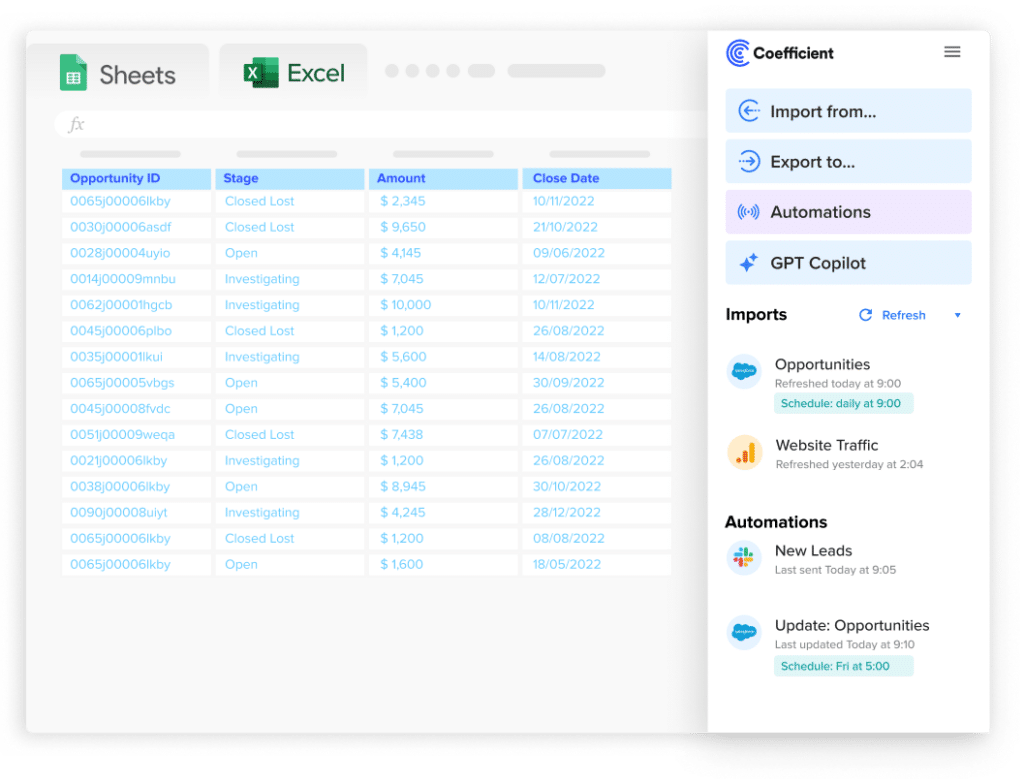
Stop exporting data manually. Sync data from your business systems into Google Sheets or Excel with Coefficient and set it on a refresh schedule.
Get Started
- Monthly close processes
- Budget collection
- Financial statement generation
Performance is more than adequate. You’re not running real-time operational dashboards; you’re building financial models that refresh daily or on-demand.
Reliability is strong, with customer reviews consistently praising uptime and data accuracy. The platform handles multi-entity consolidation with complex intercompany eliminations, and version control ensures you’re never losing work due to file corruption or conflicting edits. For finance workflows that demand accuracy and audit trails, Datarails delivers reliability where it counts.
The limitations both platforms share
Despite their strengths, both Cube and Datarails leave significant gaps that many mid-market teams will encounter quickly.
Neither platform offers two-way sync capabilities. Both are fundamentally extraction tools—they pull data from source systems into spreadsheet environments, but you cannot write data back to source systems. If you need to:
- Update Salesforce opportunity stages based on spreadsheet analysis
- Bulk-update customer records in your CRM
- Push calculated fields back to your database
Neither platform supports that workflow. Data flows one direction only.
Both platforms require significant upfront investment. Cube starts at $20,000+ annually, while Datarails typically costs $36,000-60,000+ per year. For lean teams without dedicated FP&A budgets, these price points can be prohibitive, especially when you need to justify ROI before implementation.
Platform limitations create challenges for growing companies. Cube’s constraints with multi-dimensional models and complex consolidations may frustrate teams as they scale. Datarails’ Excel-only approach excludes the 40% of organizations using Google Workspace and limits cross-functional adoption.
Neither delivers true cross-functional value. Cube focuses on small business finance teams, while Datarails serves Excel-based finance departments. If your organization needs unified data access across departments:
- Finance pulling NetSuite and Salesforce data
- Marketing analyzing Google Ads alongside Stripe revenue
- Operations tracking Jira project costs against budgets
You’ll need multiple tools or a different solution entirely.
Enter Coefficient: A superior alternative

What if you could get the direct business system connectivity of both platforms without the high costs? The flexibility to work in both Excel AND Google Sheets instead of being locked into one? Two-way sync capabilities that neither Cube nor Datarails offers? Finance, marketing, sales, and operations data in one platform at a fraction of the price? That’s Coefficient.
The platform connects directly to core financial systems: NetSuite, QuickBooks, Sage Intacct, Xero, Stripe. Finance teams build live P&L reports and cash flow dashboards. But Coefficient also connects to 100+ systems across sales (Salesforce, HubSpot), marketing (Google Ads, Facebook Ads), data infrastructure (Snowflake, BigQuery), and operations (Jira, Asana).
And all with extremely transparent and affordable pricing:
Free: $0/month
- 3 data sources, 1 user, 5,000 rows, manual refresh
Starter: $49/month
- Single user, 500 refreshes/month, daily auto-refresh, snapshots, 100 alerts
Pro: $99/user/month
- Unlimited rows, hourly auto-refresh, 5,000 refreshes/month, 300 alerts, multi-user (up to 10), two-way sync
Enterprise: Custom pricing
- Unlimited refreshes/alerts, admin controls, SSO
Annual billing saves 17% on all paid tiers.

The philosophy is different: cross-functional teams who need unified data access, not department-specific solutions. When your CFO wants to understand customer acquisition costs, they need marketing spend AND revenue data, accounts payable AND operational expenses, product usage AND sales performance. Coefficient handles those cross-functional questions.

Specific advantages over Cube
Where Cube requires $20,000+ annually for entry-level access, Coefficient delivers robust connectivity at $99/user/month. A five-person finance team costs $495/month on Coefficient versus $1,250+ on Cube—less than half the price with more flexibility.
Cube focuses on small businesses with limitations on complex models. Coefficient scales from startups to enterprises without dimensional constraints or drill-down limitations. You’re not locked into a platform that you’ll outgrow.
Cube provides one-way data extraction only. Coefficient’s two-way sync lets you update source systems directly from spreadsheets—transforming them from reporting tools into operational interfaces.
Finally, Coefficient serves cross-functional teams, not just finance. One platform, one pricing model, serving sales, marketing, operations, and finance instead of requiring separate tools for each department.
Specific advantages over Datarails
Where Datarails costs $3,000-5,000+/month for Excel-only functionality, Coefficient delivers both Excel AND Google Sheets support at roughly one-quarter the cost. A 20-person team costs $1,980/month on Coefficient versus $3,000+ minimum for Datarails.
Datarails excludes the 40% of organizations using Google Workspace. Coefficient’s native support for both platforms ensures your entire team can access data regardless of spreadsheet preference.
Like Cube, Datarails offers only one-way extraction. Coefficient’s bidirectional connectivity lets you push updates back to Salesforce, HubSpot, QuickBooks, and databases.
Datarails requires process changes with specific workflows and templates. Coefficient works with your existing spreadsheet models—no rebuilding required.
Unique features neither competitor offers
Two-way sync is the capability that most clearly differentiates Coefficient. For operational workflows—updating CRM records, managing inventory levels, adjusting pricing—this bidirectional capability is transformative.
Equal native support for Excel AND Google Sheets with identical functionality ensures no team member is excluded based on platform choice.
The breadth of 70+ integrations across all business functions positions Coefficient as a true cross-functional platform rather than a department-specific tool.
Same-day implementation without IT involvement or extensive training gets teams productive immediately, not after weeks of onboarding.
The verdict
Cube is the right choice if you’re a small business finance team who needs accessible FP&A functionality, works within Excel or Google Sheets, can afford $20,000+ annually, and won’t outgrow its dimensional limitations.
Datarails works if you’re a finance team working exclusively in Excel who needs sophisticated FP&A workflows with multi-entity consolidation and can invest $36,000-60,000+/year.
But for most mid-market teams caught between these extremes—teams that need robust data connectivity across all business functions, use both Excel and Google Sheets, want self-service access without complexity, need two-way sync, and require predictable pricing with clear ROI—Coefficient represents a superior alternative.
The platform delivers:
- Cross-functional breadth
- Self-service accessibility
- Pricing transparency
- Unique capabilities—two-way sync, dual Excel/Google Sheets support, same-day implementation
That neither competitor matches.
Customer results speak for themselves:
- Cyrq Energy avoided $50,000+ in annual costs
- Solv automated workflows and saved 364 hours annually
- Klaviyo enabled faster, better analysis by everyone—”especially those that can’t code”
You don’t have to choose between startup limitations and enterprise complexity, between expensive FP&A suites and basic solutions, between Excel and Google Sheets, between finance-only tools and cross-functional connectivity. There’s a third path—one that combines power with simplicity, breadth with affordability, and automation with accessibility.Ready to see how Coefficient transforms data connectivity for your team? Get started with Coefficient today and connect your first data source in minutes, not weeks.