Your finance team has outgrown manual Excel consolidation. The copy-paste cycles, version control problems, and disconnected data sources prevent strategic work. You need automation, but the core question remains: do you need a specialized FP&A platform, or universal data connectivity that serves your entire organization?
Both Coefficient and Cube FP&A work within Excel and Google Sheets. They take different approaches to solving finance team challenges.
Cube FP&A is a dedicated financial planning platform built exclusively for finance teams, offering sophisticated budgeting, forecasting, and consolidation workflows. Coefficient is a universal data connectivity platform that brings live data from 100+ business systems into spreadsheets for teams across your entire organization.
- Coefficient vs Cube FP&A: Core differences
- Coefficient vs Cube FP&A: Integration ecosystem
- Coefficient vs Cube FP&A: Features and functionality
- Coefficient vs Cube FP&A: Pricing comparison
- Coefficient vs Cube FP&A: User experience
- Coefficient vs Cube FP&A: Customer support
- Coefficient vs Cube FP&A: Which should you choose?
- Transform spreadsheets into your data platform
Coefficient vs Cube FP&A: Core differences
The fundamental choice centers on scope and philosophy about how modern finance teams operate.
What is Cube FP&A?

Christina Ross built Cube from her experience as a serial CFO at companies like Rent the Runway and Criteo. She watched multiple FP&A implementations fail because they forced finance teams to abandon spreadsheets they’d spent years perfecting. Her solution: extend Excel and Google Sheets with cloud-powered FP&A capabilities rather than replacing them.
Cube’s positioning focuses on finance exclusivity: “Built by finance, for finance.” The platform specializes in workflows finance teams need:
- Annual budgeting and rolling forecasts
- Multi-entity consolidation with complex eliminations
- Scenario planning and financial close automation
When you implement Cube, you bring in a dedicated FP&A platform that operates within spreadsheets. The platform connects to ERPs, accounting systems, HR platforms, and CRM tools, consolidates financial data into a structured repository, and provides purpose-built planning tools.
The 90-day implementation includes platform setup, data mapping, and training. You’re investing $20,000+ annually for specialized finance functionality with hands-on support.
What is Coefficient?

Coefficient makes spreadsheets the universal interface for business data across your organization. Finance teams get connections to NetSuite, QuickBooks, Sage Intacct, and Xero. Sales teams access Salesforce and HubSpot. Marketing pulls from Google Ads and Mailchimp. Operations connects Jira and MySQL databases.
Everyone works in the spreadsheet interface they already understand, with live data from their systems. The platform operates through a sidebar in Excel and Google Sheets, providing:
- 100+ data source connections across all business functions
- Hourly automatic refresh keeping data current
- Two-way sync with Salesforce, HubSpot, and databases
This is Coefficient’s core value proposition: providing a 360-degree view of your business. Take SolvHealth, for example. They leveraged Coefficient to automate their accounting close process, creating a single source of truth for financial reporting. The result? They saved “at least a full day of work each month.” This is the power of a unified data platform in action.

Coefficient vs Cube FP&A: Integration ecosystem
Integration capabilities determine what analysis you can perform and which teams benefit.
Integration comparison table
| Integration Type | Cube FP&A | Coefficient |
| ERP/Accounting | NetSuite, QB, Sage, Dynamics, Xero | NetSuite, QB, Sage, Xero, Stripe |
| HR Systems | Workday, ADP, BambooHR, Rippling | Workday, ADP, BambooHR |
| CRM Platforms | Salesforce, HubSpot (finance only) | Salesforce, HubSpot (two-way sync) |
| Marketing Tools | ❌ None | Google Ads, Facebook Ads, Mailchimp |
| Databases | Via data warehouse only | Direct MySQL, PostgreSQL, SQL Server |
| Operations | ❌ None | Jira, Asana, Monday.com, GitHub |
| Total Systems | 60+ finance-focused | 100+ cross-functional |
Cube FP&A: Finance depth without breadth
Cube offers approximately 60 integrations focused on systems finance teams use. When Cube connects to your ERP, it pulls general ledger data, chart of accounts, dimensions, and historical actuals for planning models. When connecting to HRIS, it extracts headcount, compensation, and organizational structure for workforce planning.
Everything flows into Cube’s multi-dimensional data cube—a centralized repository designed for FP&A workflows. These integrations serve finance-specific data extraction and consolidation needs well.
What’s missing: marketing platforms, operational tools, and direct database connectivity. When finance needs customer acquisition cost combining QuickBooks expenses and Google Ads spend, Cube can’t connect to advertising platforms. When calculating project ROI requires Jira data alongside financial metrics, Cube lacks operational integrations.
Coefficient: Financial foundation plus everything else

Coefficient connects 100+ systems spanning every business function. The platform matches Cube’s financial system coverage while extending far beyond:
- Direct database access: Connect MySQL, PostgreSQL, SQL Server, and Oracle without routing through data warehouses. Engineering maintains a production database with real-time metrics? Finance queries it directly.
- Marketing intelligence: Pull Google Analytics, Google Ads, Facebook Ads, and Mailchimp data for complete marketing attribution and ROI calculations.
- Operational visibility: Access Jira, Asana, Monday.com, and GitHub for project tracking alongside financial data.
The self-serve model means teams configure connections themselves in minutes. Click “Add Connection,” authenticate, start querying immediately. No implementation project or data mapping exercise required.
Coefficient vs Cube FP&A: Features and functionality
Both platforms work within spreadsheets but deliver different capabilities.
Feature comparison table
| Feature | Cube FP&A | Coefficient |
| Multi-Entity Consolidation | ✅ Advanced with eliminations | Via spreadsheet formulas |
| Scenario Planning | ✅ Built-in workflows | Build custom models |
| Rolling Forecasts | ✅ Structured templates | Create with live data |
| Two-Way Sync | ❌ Read-only | ✅ 6+ major systems |
| AI Capabilities | Finance-specific AI | General AI assistant |
| Data Refresh | Scheduled syncs | Hourly auto-refresh |
| Platform Support | Excel and Google Sheets | Excel and Google Sheets |
| Alerts | ❌ None | ✅ Slack and email |
Cube FP&A: Structured finance workflows
Cube provides purpose-built FP&A functionality:
- Data management engine consolidates information from source systems with automated syncing
- Multi-scenario analysis models optimistic, realistic, and pessimistic cases without complex spreadsheet versions
- Automated variance analysis compares actuals to budget and generates variance narratives
Financial consolidation stands out. Managing multiple entities with different ERPs or charts of accounts? Cube handles mapping and roll-ups automatically. Plan bottom-up by department, consolidate top-down to corporate. Track changes with version control creating audit trails for compliance.
Cube AI adds finance-specific intelligence. It generates forecast predictions from historical patterns, highlights anomalies, and drafts executive summaries understanding P&L structures and balance sheet relationships.
Coefficient: Flexible data connectivity
Coefficient focuses on data access, automation, and self-service capabilities:
- Live data import from 100+ systems with automatic hourly refresh
- AI Sheets Assistant builds dashboards, writes SQL, creates pivot tables using natural language
- Two-way sync lets you update Salesforce, HubSpot, and databases directly from spreadsheets
The AI assistant makes advanced features accessible. Describe what you need: “Build a dashboard showing QuickBooks revenue by customer with conditional formatting.” The AI builds it. No SQL knowledge or technical skills required.
Automated alerts ensure teams get data when needed. Send weekly sales dashboards via Slack. Email finance reports at month-end. Trigger notifications when metrics exceed thresholds. Snapshots capture point-in-time data for historical comparisons.
Coefficient vs Cube FP&A: Pricing comparison
Understanding true costs requires examining both advertised prices and total investment.
Pricing breakdown table
| Element | Cube FP&A | Coefficient |
| Starting Price | ~$20,000/year | $588/user/year |
| Typical Cost | $1,500-2,800/month | $49-99/user/month |
| Pricing Model | Custom quotes only | Transparent tiers |
| Onboarding Fees | Additional cost | None (self-serve) |
| Free Trial | ❌ Demo only | ✅ Free plan available |
| Included Systems | 60+ finance-focused | All 100+ integrations |
| User Limits | Unlimited users | Per-user pricing |
Cube FP&A: Enterprise investment

Cube uses custom pricing starting around $20,000 annually. Third-party sources suggest:
- $1,500/month for lean finance teams
- $2,800/month for growth companies
- Custom pricing for larger enterprises
This includes unlimited users, templates, dimensions, scenarios, and dashboards. However, onboarding fees add to total investment, covering platform setup, integration, mapping, and 90-day support.
You speak with sales, they assess requirements, they quote based on company size, entities, and complexity. This is an enterprise purchase requiring budget approval and implementation planning.
Coefficient: Transparent scaling

Coefficient publishes clear per-user pricing:
- Starter: $588/user/year with core features
- Pro: $1,188/user/year with advanced capabilities
- Enterprise: Custom pricing for additional security and support
A five-person finance team costs $2,940-5,940 annually—significantly less than Cube’s starting point. This includes all 100+ integrations, unlimited refreshes, AI assistant, and two-way sync. No onboarding fees because the platform is self-service.
The free plan lets teams test before committing budget. This reduces risk compared to Cube’s enterprise sales cycle requiring demos and contracts.
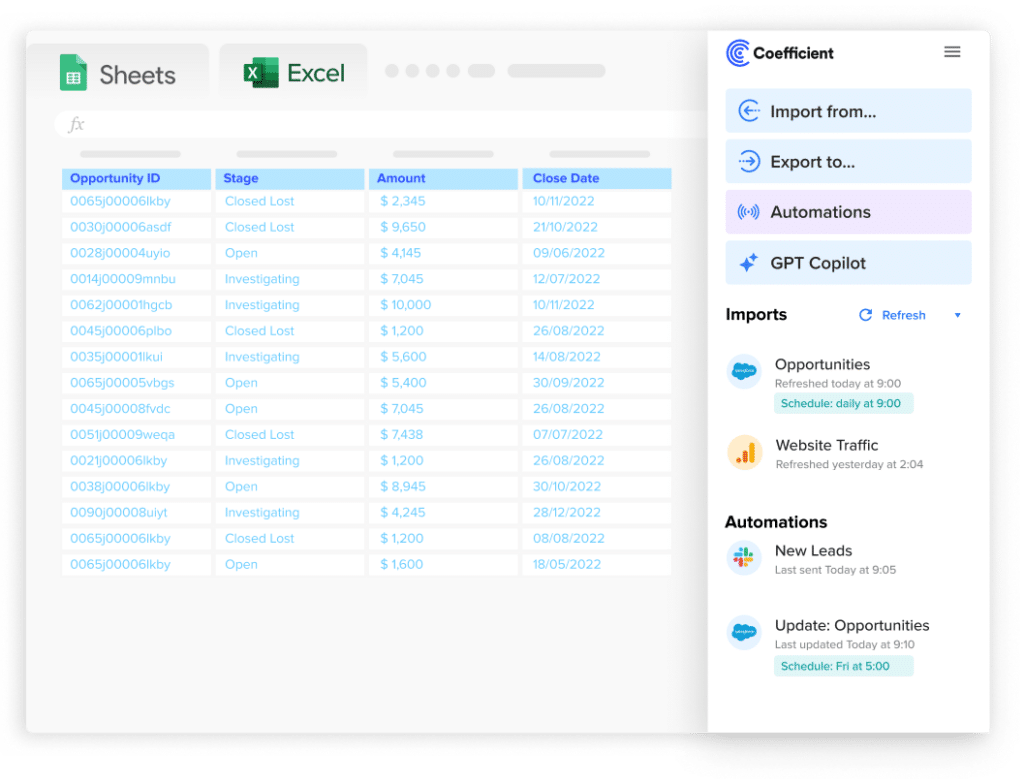
Stop exporting data manually. Sync data from your business systems into Google Sheets or Excel with Coefficient and set it on a refresh schedule.
Get Started
Coefficient vs Cube FP&A: User experience
Both platforms work within spreadsheets but deliver different implementation experiences.
Cube FP&A: Guided implementation
Cube provides add-ins for Excel and Google Sheets plus a web-based Workspace application. The interface emphasizes financial workflows—build planning templates, set up reporting structures, define dimensions, configure consolidation rules.
New customers go through 90-day onboarding with Customer Success Engineers handling:
- Platform setup and data source integration
- Data mapping and template configuration
- Team training and ongoing support
The platform assumes you understand FP&A concepts—variance analysis, rolling forecasts, scenario planning. Some reviews mention “rough” initial implementations with time-consuming setup. The investment makes sense for complex operations but delays time-to-value.
Coefficient: Immediate self-service
Coefficient operates through a sidebar panel in spreadsheets. Select your data source, choose objects and fields, data populates automatically. The interface stays minimal—you work in familiar spreadsheets with Coefficient providing connectivity in the background.

Setup takes minutes for most integrations. Authenticate, grant permissions, start importing. No implementation project, no customer success engineer, no training beyond understanding the sidebar interface.
The AI assistant enhances accessibility. Describe needs in plain language rather than learning query builders or API structures. This natural language interface makes advanced features available to non-technical users immediately.
Coefficient vs Cube FP&A: Customer support
Support models reflect the fundamental product differences.
Support comparison table
| Support Feature | Cube FP&A | Coefficient |
| Onboarding | 90-day guided implementation | Self-service |
| Support Model | Dedicated Success Engineers | Tiered by plan |
| Documentation | FP&A workflow focused | Technical + use cases |
| Training | Required sessions | Optional/AI-assisted |
| Community | Limited | Active resources |
Cube FP&A: White-glove service
Every Cube customer gets Customer Success Engineers guiding implementation. Reviews praise the team as “responsive” and “helpful” with direct access to FP&A experts. The company wins G2 awards for support quality and implementation speed.
Case studies show quantified results like Edge Fitness Clubs saving $300,000 annually and Sky Ranch achieving 100% data accuracy. This hands-on approach ensures complex implementations succeed.
Coefficient: Scalable enablement
Coefficient provides tiered support—standard plans get email support, premium plans add priority response and dedicated managers. Implementation assistance is optional since most customers self-configure.
The AI assistant provides built-in support by answering questions and building solutions. Rather than searching documentation, users describe needs and the AI delivers. The knowledge base contains guides, videos, and examples for self-service learning.
Coefficient vs Cube FP&A: Which should you choose?
Choose Cube FP&A if:
Your needs are exclusively financial planning:
- You manage multiple entities requiring complex consolidation
- You need structured budgeting and forecasting workflows
- You have $20,000+ annually for finance-specific platform
Cube delivers value for companies where finance drives planning and other departments consume outputs. Edge Fitness achieved 50% reporting time reduction. Sky Ranch’s CFO spends majority time on strategic work. These outcomes reflect what purpose-built FP&A platforms accomplish.
Choose Coefficient if:
You need financial data plus business context:
- Finance requires pipeline visibility from Salesforce
- You calculate metrics combining accounting and marketing data
- Multiple teams need self-serve data access
You want faster implementation:
- Start analyzing data immediately without 90-day onboarding
- Give teams instant access without training requirements
- Scale gradually as needs evolve
Budget matters:
- Coefficient costs fraction of Cube’s price
- Per-user model enables broader deployment
- Free plan allows testing before purchase
Transform spreadsheets into your data platform
Your teams don’t need to choose between FP&A workflows and organization-wide data access. You don’t need to force departments to request reports when they could access data themselves. You don’t need specialized platforms when connected spreadsheets deliver the same outcomes with greater flexibility.
Get started with Coefficient and give every team the data they need:
- Connect NetSuite, QuickBooks, Salesforce, and 100+ other systems
- Enable finance teams with live financial data for planning and analysis
- Empower sales, marketing, and operations with self-serve analytics
Break down data silos. Enable faster decisions. Transform the spreadsheets your teams already know into powerful business intelligence tools. Start free today—no sales calls, no implementation projects, just immediate access to the data that drives your business.